Contents
Scroll to:
https://doi.org/10.37489/2949-1924-0146
EDN: PZVRWH
Scroll to:
Introduction. Depressive disorders are a significant medical and social issue, particularly among young people, including medical students, due to high academic loads and stressful factors.
Objective. To determine the prevalence and structure of depressive symptoms among students of the International Medical Institute of Kursk State Medical University (IMI KSMU).
Materials and methods. A cross-sectional study was conducted from September to October 2025 involving 60 students aged 18–25 years. The Beck Depression Inventory was used to assess the level of depression, and the data were processed using descriptive statistics.
Results. Mild depression (5–9 points) was found in 40 % of respondents, moderate (10–14 points) in 23 %, and severe or very severe forms (15–27 points) in 22 %, while only 15 % of participants had no significant symptoms (0–4 points). The most common symptoms were low mood, fatigue, difficulty concentrating, and sleep disturbances. Suicidal thoughts were reported by 6.7 % of the respondents.
Conclusion. The findings indicate a high level of emotional distress among students and highlight the need for implementing psychological support programs, resilience training, and prevention of depressive states in academic settings.
Medvedenko N.Y., Borodulin W.P., Borodulin R.P. Epidemiology and structure of depressive disorders among medical students. Patient-Oriented Medicine and Pharmacy. 2026;4(2):107-112. (In Russ.) https://doi.org/10.37489/2949-1924-0146. EDN: PZVRWH
Depressive disorders are among the most prevalent mental health conditions, affecting approximately 5% of the adult population according to World Health Organization estimates. The clinical presentation of depression includes anhedonia, feelings of worthlessness, cognitive impairments (attention and memory), sleep disturbances, and suicidal ideation. Depression is a leading cause of disability and exerts a pronounced negative impact on educational trajectories, professional productivity, and overall quality of life. When emerging at a young age and in the absence of adequate treatment, depression increases the risk of developing substance use disorders, somatic pathology (particularly cardiovascular diseases), and premature mortality.
Existing therapeutic approaches include pharmacotherapy (selective serotonin reuptake inhibitors, tricyclic antidepressants) and psychotherapeutic methods, primarily cognitive-behavioral therapy. According to meta-analyses of randomized placebo-controlled trials, 56–60% of patients demonstrate a positive response to pharmacological treatment. However, pharmacotherapy is associated with risks of adverse effects, delayed onset of action, potential for relapse, and limited efficacy in mild forms. Psychotherapeutic support is also often difficult to access due to organizational and social barriers [1].
Despite significant progress in depression research over recent decades, the literature remains fragmented, and interpretation of findings is complicated by heterogeneity in study designs. Interdisciplinary exchange between genetics, neurobiology, immunology, and psychology remains insufficient [2]. Existing reviews of depression determinants are often limited to specific groups of factors or subpopulations, failing to account for the multilevel context. A comprehensive approach integrating biological, psychological, and social determinants with consideration of the life course enables the development of personalized prevention and treatment strategies [3, 4].
To determine the prevalence and severity of depressive symptomatology, as well as to analyze the structure of the most frequent clinical manifestations of depression among students of the International Medical Institute of Kursk State Medical University (IMI KSMU).
The study was conducted at the Faculty of Medicine of IMI KSMU during the period from September to October 2025. The sample comprised 60 students aged 18 to 25 years, representing various years of study. Participation was voluntary and anonymous. All respondents were informed of the study objectives and provided verbal consent to participate.
The Russian-language version of the Beck Depression Inventory (BDI) was used to assess the severity of depressive symptomatology. The instrument includes 21 items, each rated on a four-point scale (from 0 to 3 points). The maximum total score is 63. Results were interpreted according to the standard classification: 0–4 points — minimal depression; 5–9 — mild depression; 10–14 — moderate depression; 15–19 — severe depression; 20–27 — very severe depression.
Respondents completed the questionnaires independently, selecting response options that most closely corresponded to their current psycho-emotional state. Data collection and processing were performed anonymously. Descriptive statistics methods were employed for statistical analysis, including calculation of frequencies, percentages, and mean values. Data processing and visualization were carried out using Microsoft Excel software.
The study was conducted in accordance with the ethical principles of the Declaration of Helsinki (revised 2024) and internal university regulations. Personal data of participants were not collected; results were used in aggregated form exclusively for scientific purposes.
A total of 60 IMI KSMU students participated in the study. The distribution of respondents by depression levels is presented in Figure 1. According to the results, 9 individuals (15%) were classified into the group with minimal depression (0–4 points). Mild symptoms (5–9 points) were recorded in 24 students (40%), moderate symptoms (10–14 points) in 14 (23%), severe symptoms (15–19 points) in 7 (12%), and very severe symptoms (20–27 points) in 6 (10%) participants. Thus, the total proportion of students with moderate and more severe forms of depression (groups 3–5) was 45% (27 individuals), indicating a substantial level of emotional distress in the surveyed population.
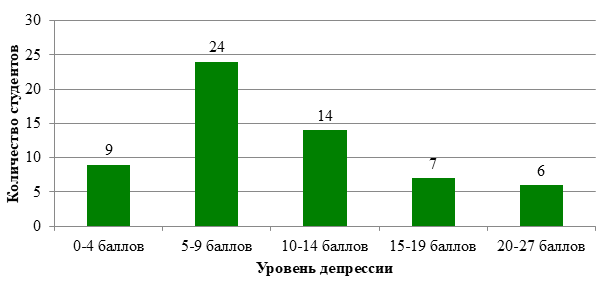
Fig. 1. Distribution of depression levels among students of IMI KSMU (n=60)
Analysis of individual symptom structure (Table 1) revealed that mild loss of interest/anhedonia (1 point) was reported by 43.3% of respondents, while moderate and severe manifestations were observed in a total of 30%. Mild depressed mood was recorded in 51.7% (n=31), while moderate and marked sadness/hopelessness were present in 31.7% (n=19). Sleep disturbances: absence of complaints (0 points) and mild difficulties (1 point) were equally distributed at 30% each; significant sleep disturbances (2–3 points) were identified in 40% of respondents.
Feelings of fatigue/reduced energy to some degree were experienced by 63% of participants, with severe asthenia (3 points) noted in 18.3% (n=11). Appetite changes were absent in 30% of respondents; mild disturbances were recorded in 35%, while moderate and severe disturbances were observed in 25% and 10%, respectively. Feelings of guilt and self-criticism: absent in 25% (n=15); mild manifestations in 38.3% (n=23); moderate and severe in a total of 36.6% (n=22). Mild concentration impairment was identified in 41.7% (n=25), while moderate and severe difficulties were observed in 40% (n=24). Psychomotor retardation/inner restlessness was absent in 38.3% (n=23), mild manifestations in 40% (n=24), and moderate/severe in 21.7% (n=13).
The most concerning finding is the presence of suicidal thoughts: 16.7% (n=10) reported rare or mild thoughts of self-harm, 5% (n=3) reported periodic pronounced thoughts, and 1.7% (n=1) reported serious thoughts of not wanting to live. Thus, a total of 23.4% of participants demonstrate suicidal ideation of varying severity, which requires immediate attention from psychological services.
Table 1. Distribution of participants' responses by depressive spectrum symptoms (n=60)
| Indicator | 0 points | 1 point | 2 points | 3 points |
|---|---|---|---|---|
| Loss of interest / anhedonia | 26.7% | 43.3% | 18.3% | 11.7% |
| Depressed mood | 16.7% (n=10) | 51.7% (n=31) | 15% (n=9) | 16.7% (n=10) |
| Sleep disturbances | 30% | 30% | 21.7% | 18.3% |
| Fatigue / reduced energy | 18.3% (n=11) | 35% (n=21) | 28.3% (n=17) | 18.3% (n=11) |
| Appetite changes | 30% | 35% | 25% | 10% |
| Feelings of guilt / self-criticism | 25% (n=15) | 38.3% (n=23) | 18.3% (n=11) | 18.3% (n=11) |
| Concentration impairment | 18.3% (n=11) | 41.7% (n=25) | 26.7% (n=16) | 13.3% (n=8) |
| Psychomotor retardation / restlessness | 38.3% (n=23) | 40% (n=24) | 10% (n=6) | 11.7% (n=7) |
| Thoughts of self-harm / suicidal ideation | 76.7% (n=46) | 16.7% (n=10) | 5% (n=3) | 1.7% (n=1) |
The obtained data are consistent with results from other studies indicating a high prevalence of depressive symptomatology among medical students. The identified high level of asthenic and cognitive impairments (fatigue, reduced concentration) may be considered a consequence of chronic academic overload and insufficient recovery periods. The significant proportion of individuals with sleep disturbances (40%) and emotional lability confirms the need for early screening and implementation of preventive interventions.
When interpreting the results of this study, several methodological limitations must be considered.
Study design. The cross-sectional design does not allow for the establishment of causal relationships between the identified depressive symptomatology and potential predictors (academic load, socio-economic factors, personality traits), nor does it permit assessment of the dynamics of the condition over time.
Sample size. The relatively small sample size (n=60) limits the statistical power of the study and the ability to extrapolate the obtained data to the entire population of medical students. The results should be considered preliminary.
Screening instrument. The use of the Beck Depression Inventory (BDI), which is a validated and widely used screening tool, does not replace clinical psychiatric interview. The BDI allows for assessment of subjective symptom perception but is not a diagnostic method according to DSM-5 criteria. Both overdiagnosis (due to situational stress at the time of survey) and underdiagnosis (due to denial or dissimulation of symptoms) are possible.
Self-report and social desirability. The data are based exclusively on self-report, which increases the risk of systematic bias related to subjective perception, social desirability effects, or insufficient reflection of one's own condition. The absence of a clinical verification stage does not allow confirmation of the reliability of all registered cases.
Sample homogeneity. The study included only students from a single university (IMI KSMU), predominantly studying at the Faculty of Medicine. This limits the generalizability of the results to other educational institutions, specialties (particularly non-medical profiles), or regions with different sociocultural conditions.
Temporal factor. The study was conducted in September–October, which coincides with the beginning of the academic year and the period of adaptation to a new academic cycle. The influence of seasonal mood fluctuations cannot be excluded, which may have affected the prevalence of symptoms in the direction of their increase.
Lack of control for external variables. The study did not account for potential confounding factors such as family history of psychiatric disorders, previous depressive episodes, presence of chronic somatic pathology, psychoactive substance use, or level of social support, which could have enriched the analysis.
In view of the above, the presented data require confirmation in larger prospective studies incorporating clinical verification and multifactorial statistical modeling.
The conducted study demonstrated that depressive symptoms of varying severity are registered in 85% of IMI KSMU students, with 45% reaching moderate or severe levels. The most frequent manifestations are depressed mood, asthenia, cognitive impairments, and sleep disturbances. Suicidal thoughts of any severity (1–3 points) were recorded in 23.4% (n=14) of respondents, with severe suicidal ideation (3 points) noted in 1.7% (n=1), underscoring the critical importance of organizing accessible psychological assistance.
The obtained results justify the need for systematic measures, including regular monitoring of students' psycho-emotional state, development of training programs in stress management and emotional self-regulation skills, as well as the creation of accessible psychological counseling channels within the university structure.
1. Hengartner MP, Passalacqua S, Andreae A, et al. Antidepressant Use During Acute Inpatient Care Is Associated With an Increased Risk of Psychiatric Rehospitalisation Over a 12-Month Follow-Up After Discharge. Front Psychiatry. 2019 Feb 22;10:79. doi: 10.3389/fpsyt.2019.00079.
2. Saracino RM, Nelson CJ. Identification and treat-ment of depressive disorders in older adults with cancer. J Geriatr Oncol. 2019 Sep;10(5):680-684. doi: 10.1016/j.jgo.2019.02.005.
3. Tanner J, Zeffiro T, Wyss D, et al. Psychiatric Symptom Profiles Predict Functional Impairment. Front Psychiatry. 2019 Feb 13;10:37. doi: 10.3389/fpsyt.2019.00037.
Natalia Y. Medvedenko - Assistant Professor of the Department of Neurology
Kursk
The authors declare that there are no obvious or potential conflicts of interest associated with the content of this article.
William P. Borodulin - student
Kursk
The authors declare that there are no obvious or potential conflicts of interest associated with the content of this article.
Richard P. Borodulin - student
Kursk
The authors declare that there are no obvious or potential conflicts of interest associated with the content of this article.
Medvedenko N.Y., Borodulin W.P., Borodulin R.P. Epidemiology and structure of depressive disorders among medical students. Patient-Oriented Medicine and Pharmacy. 2026;4(2):107-112. (In Russ.) https://doi.org/10.37489/2949-1924-0146. EDN: PZVRWH
НАШИ КНИГИ





Другие журналы
"Издательства ОКИ"



.png)
ПАРТНЕРЫ

 Email this article (Login required)
Email the author (Login required)
Email this article (Login required)
Email the author (Login required) 115522, Moscow, st. Moskvorechye, 4, building 5, apt. 129, OKI Publishing House LLC
Processing of personal data